
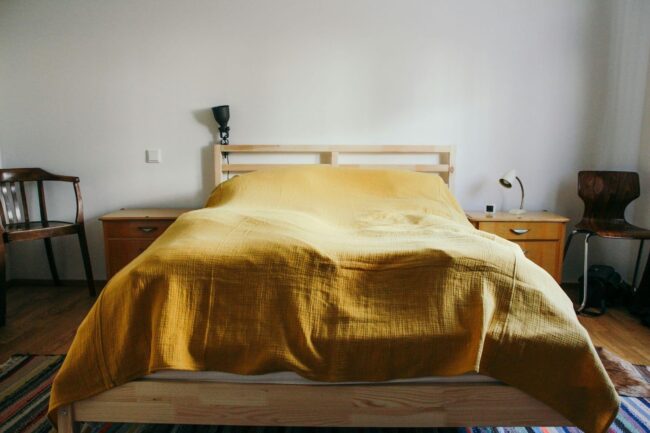
Photo by Brina Blum on Unsplash
Bedrooms reflect more than taste. They reveal how people prioritize rest, stability and the long-term usability of the space they return to every night. When the room relies on materials that degrade quickly, sleep, comfort and design all suffer. A solid wood bed reframes the conversation because its presence reintroduces something the modern furniture market has conveniently forgotten. Durability is a functional requirement, not an aesthetic choice.
This article examines how solid wood beds became the standard, why cheaper alternatives gained traction, why those alternatives failed and what modern homeowners actually need from the most important piece of furniture in their home.
How Solid Wood Became the Original Bedroom Architecture
Historically, beds were not decorative objects. They were infrastructure. Before mass production existed, most households relied on local craftsmen who understood the relationship between materials, weight distribution and longevity. A bed was expected to withstand years of shifting sleepers, humid seasons and uneven flooring. Wood dominated because it was available, workable and strong.
Early bed frames were often simple but structurally exact. Mortise and tenon joints kept the frame aligned. Thick posts resisted lateral movement. Slats held mattresses without sagging. Even the most modest designs reflected an understanding of proportion and physics. The material allowed for refinement without fragility.
The shift began once manufacturing scaled. Lighter metals and engineered composites promised convenience. Consumers saw lower cost and faster delivery, and the industry leaned into the idea that a bedroom could evolve as often as a wardrobe. Construction methods shifted from craft to efficiency, and design language changed to emphasize aesthetics rather than structure.
Why Modern Bed Frames Lost Their Reliability
Contemporary bed frames fail for reasons built directly into their design. Composite wood bows under humidity changes. Veneers peel when exposed to friction. Metal frames flex under repeated weight shifts. Bolts loosen gradually because the frame lacks the density to hold pressure. These failures are not dramatic. They are incremental, which makes them easy to ignore until sleep quality begins to deteriorate.
Another issue lies in how furniture companies prioritize assembly. Quick-build bed frames rely on minimal hardware and thin panels that can be boxed and shipped efficiently. This reduces production costs, but it also reduces the lifespan of the furniture. A frame that assembles in minutes also tends to decline in the same fashion.
The market created a culture of disposability. A bed became a consumable. Consumers accepted instability as a reasonable tradeoff for price and convenience, even when the foundation of the bedroom began to feel increasingly temporary.
What Modern Consumers Actually Need From a Bed
The current generation of homeowners and renters faces a different set of pressures than earlier eras. They work longer hours, manage more unpredictable schedules and rely heavily on their bedrooms as recovery spaces. Sleep quality has become a measurable health priority rather than a lifestyle preference. Under these conditions, the bed frame is no longer just a furniture decision. It becomes part of environmental health.
Modern consumers need a bed that accomplishes three things simultaneously. First, it must remain structurally stable for the long term. Movement, noise and flexing interrupt sleep and ripple into daily routines. Second, it should support the mattress in a way that preserves its lifespan, since mattress failure often appears when the frame loses alignment.
Third, it should contribute to the room’s atmosphere without becoming visually disposable.
A solid wood bed meets these needs because its strength comes from density, joinery and material integrity rather than mechanical shortcuts. Households that invest in wood are choosing a stable foundation rather than a trend-driven placeholder.
A Step-by-Step Breakdown of Functional Bed Design
Step 1: Begin with structural weight
A bed frame must resist movement, and that begins with physical mass. Lightweight frames shift because they lack the density required to stay anchored. Solid wood reduces motion transfer and creates a grounded foundation.
Step 2: Use joinery that distributes pressure
Durable bed frames rely on construction methods that move stress through the structure instead of concentrating it at weak points. Traditional joinery techniques accomplish this naturally, which is why heritage designs persist.
Step 3: Support the mattress with consistent alignment
A sagging mattress is often the result of the frame beneath it failing first. Wood slats that maintain their shape preserve mattress performance and avoid premature wear.
Step 4: Select materials that improve with age
Cheap materials deteriorate. Solid wood develops nuance in its grain and maintains integrity across decades. The aging process enhances rather than diminishes its appearance.
Step 5: Prioritize repairability
A solid wood bed can be refinished, tightened and restored. Composite frames cannot be meaningfully repaired because the material itself degrades when stressed.
Step 6: Choose designs that integrate with evolving interiors
Wood adapts. A change in bedding, lighting or wall color does not make the frame obsolete. Sustainability in design is less about marketing claims and more about longevity of use.
Metrics That Matter When Evaluating a Bed Frame
Consumers rarely evaluate furniture the way they evaluate technology or appliances, but bed frames benefit from the same clarity.
Structural lifespan
A well-built solid wood frame should hold stability for twenty years or more. Composite frames rarely last beyond five.
Movement reduction
A good frame eliminates noise and shifting entirely. If the bed reacts each time someone sits or moves, it is failing its core function.
Mattress preservation
A supportive frame extends mattress life. Frequent mattress replacements are often the result of inadequate support systems, not mattress defects.
Repair potential
A solid wood frame can be tightened, refinished or restored. A frame that cannot be repaired has a shorter, predetermined lifespan.
Environmental fit
Homes expand and contract with seasons, and furniture responds to that movement. Wood adjusts without losing integrity. Manufactured materials often warp or separate.
These signals help consumers navigate a market filled with products that look similar at first glance but behave differently once real life interacts with them.
A Bedroom Works Better When Its Foundation Does Not Fail
The modern furniture market encourages frequent replacement, quick fixes and the illusion of convenience. None of these approaches support long-term rest or domestic stability. A solid wood bed stands apart because it does not rely on novelty to justify its existence. Its value comes from structure, predictability and the ability to support a household without drawing attention to itself.
Bedrooms need fewer distractions, not more. A frame that withstands pressure, time and daily use gives the room a sense of continuity. Homes evolve, tastes shift and families grow, but the foundation of the bedroom should not require reinvention.
A well-made solid wood bed offers that foundation with clarity. It holds the room together. It absorbs life without complaint. And it remains relevant long after trend-driven furniture reaches its expiration point.