
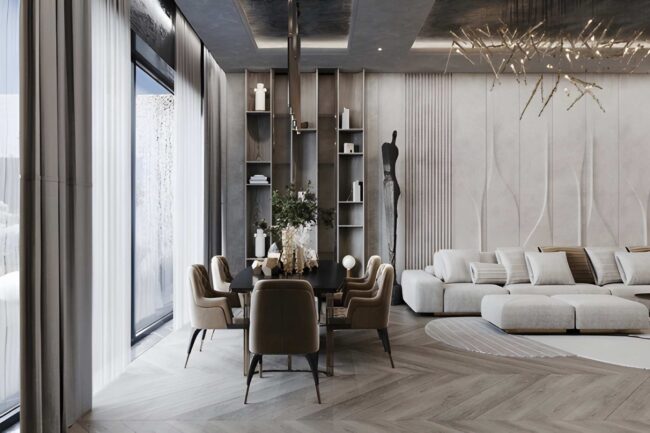
For decades, the standard advice for homeowners looking to liven up a boring room was simple: “Pick a bold color and paint one wall.” It was the era of the “pop of red” or the “navy blue focal point.” It was easy, cheap, and effective.
But as interior design matures, we are seeing a shift away from flat pigment. The most sophisticated spaces today aren’t relying on color to grab attention; they are relying on physics. They are using depth, relief, and the changing angle of the sun to create walls that feel alive.
This is the art of painting with shadows. It is the realization that a wall doesn’t need to be loud to be interesting; it just needs to be three-dimensional.
The Problem with Flatness
A painted wall, no matter how beautiful the color, is static. If you paint a wall emerald green, it is emerald green at 8:00 AM, and it is emerald green at 8:00 PM. It is two-dimensional.
The human eye, however, evolved to scan for texture. We are drawn to the complexity of a forest floor or the ripple of water—surfaces that change. When we enter a room with four flat drywall surfaces, our brain registers it as a “box.” It feels manufactured and sterile.
By adding relief—architectural elements that protrude from the surface—you break that sterility. You introduce a third dimension that interacts with the environment.
The Monochromatic Power Move
The most striking application of this concept is the “monochromatic relief.” This is where you install intricate millwork—board and batten, geometric shiplap, or reed fluting—and paint it the exact same color as the rest of the room.
To the novice, this seems counterintuitive. “If I paint the wood trim the same color as the drywall, won’t it disappear?”
The opposite happens. When you remove the distraction of high-contrast color, you force the eye to focus on the structure. The “color” of the wall is no longer provided by chemical pigment; it is provided by the shadows cast by the relief.
Consider a wall clad in vertical wood slats, painted entirely in a soft, matte white.
- At Noon: When the sun is high and bright, the wall looks crisp, clean, and almost flat.
- At Golden Hour: As the sun dips low, the light hits the slats from the side (raking light). Suddenly, deep, sharp shadows appear in the grooves. The wall transforms into a high-contrast stripe pattern.
- At Night: Under the warm glow of a floor lamp, the shadows soften, giving the room a cozy, velvet-like depth.
You haven’t changed the paint; the room has changed itself.
The Architecture of Light
Implementing this design strategy requires thinking less like a decorator and more like a lighting engineer. “Relief” only works if there is light to catch it.
If you install a stunning, textured 3D wall panel in a dark hallway with a single overhead can light, it will look flat and muddy. Texture requires “grazing” or “washing.”
- Wall Grazing: This involves placing a light fixture (like a track light or recessed gimbal) close to the wall, aiming straight down. The light skims the surface, hitting the high points and leaving the low points in darkness. This exaggerates the texture, making even shallow relief look dramatic.
- Wall Washing: This places the light further back, bathing the wall in an even glow. This softens the texture, making the wall feel smoother and more subtle.
Types of Relief
The beauty of painting with shadows is that it can be adapted to any architectural style.
- The Geometric Grid: Often used in modern or transitional homes, this involves square or rectangular grids of wood trim. It creates a sense of order and solidity. The shadows cast by the horizontal ledges add a sense of weight to the room.
- The Fluted/Reed Detail: Very popular in Art Deco and contemporary organic design, these are rounded, semi-circular dowels placed side-by-side. The curved surface creates a soft, gradient shadow rather than a hard line, making the wall feel like fabric.
- The Organic Slat: Vertical timber slats with black felt backing. This creates the deepest shadows (black voids) and offers the added benefit of acoustic dampening.
Conclusion
We are leaving the age of the “Accent Wall” as a mere splash of paint. That approach, while fun, often feels like a sticker placed on a surface. It is superficial.
The future of interior focal points is structural. It is about adding mass and integrity to the home. Whether it is through heavy molding, delicate reeding, or geometric paneling, the goal is to build a room that entertains the eye through geometry.
When you choose to design custom accent walls based on texture rather than color, you are making a timeless investment. You are trusting that the interplay of light and shadow is enough to carry the room—and as the sun moves across the sky each day, revealing new depths in your design, you will see that it is.