
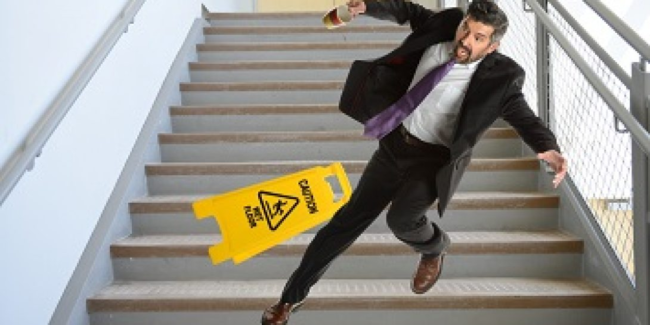
It happens in a split second. You are walking up a flight of stairs—perhaps in a dimly lit restaurant, or carrying a laundry basket in your own home. You lift your foot, you plant it, and suddenly, your toe catches. You stumble forward, shins banging into the sharp edge of the step above.
You blame your clumsiness. You blame your shoes. But in reality, you should probably blame your eyes—or rather, the optical illusion created by the staircase itself.
Tripping isn’t always a motor failure; often, it is a sensory failure. It is a phenomenon known as “Stair Blindness” (or low visual contrast), and it is the primary reason why perfectly healthy people struggle to navigate vertical spaces.
The Brain’s Autopilot
Walking is an automated process. You don’t consciously think “lift leg 7 inches, extend 12 inches, plant heel.” Your brain scans the environment, builds a 3D model of the terrain, and then hands the controls over to the motor cortex to execute the loop.
On a staircase, your brain relies entirely on edge detection. It needs to know exactly where the horizontal surface (the tread) ends and the vertical surface (the riser) begins. It uses this line to calculate the trajectory of your toe.
The problem arises when the tread and the riser look exactly the same.
The “Waterfall” Effect
Imagine a staircase covered in a busy, patterned carpet. The pattern flows over the nose of the step and down the riser without a break. This creates a “waterfall” effect. To the human eye, the individual steps disappear, merging into a single, sloped ramp of confusing visual noise.
Or consider a modern concrete staircase where the grey tread meets a grey riser under flat, overhead lighting. Without shadows to define the edge, the steps visually flatten out.
When your brain cannot clearly define the edge, it guesses. It estimates the height of the step based on the previous one. But if that estimate is off by even a fraction of an inch—or if the lighting plays tricks on your depth perception—your toe doesn’t clear the lip. You trip.
The Role of Luminance Contrast
This is why safety codes in commercial buildings are obsessed with “Luminance Contrast.”
Architects and safety engineers use a metric called Light Reflectance Value (LRV). This measures how much light a surface reflects on a scale of 0 (pure black) to 100 (pure white).
To prevent trips, the edge of the stair needs to have a significantly different LRV than the rest of the step. If you have black slate stairs (LRV 5), you need a silver or yellow strip on the edge (LRV 50+). This 30-point difference acts as a visual beacon. It screams to your subconscious: “The step ends here. Lift your foot now.”
The Descent Danger
While tripping up is painful, falling down is catastrophic. Here, the invisible tread is even more dangerous.
When looking down a monochromatic staircase, the steps often blend into a featureless void. This is called “fusing.” If you cannot distinguish the edge of the step you are standing on from the tread of the step below, you are essentially stepping into the unknown. This causes hesitation, balance loss, and the “heel slip”—where you place your foot too close to the edge because you misjudged where the edge was.
The Solution: Visual Definition
The fix for the invisible tread is rarely structural; it is visual. You don’t need to rebuild the stairs; you just need to define the line.
This is the hidden genius of the nosing strip. While often sold as a way to prevent wear and tear on the carpet or wood, its primary function is actually optical definition. A strip of matte aluminum on a dark wood stair, or a strip of black rubber on a concrete stair, breaks the visual illusion.
It provides a hard, high-contrast target for the brain. It restores the 3D model.
In homes, this is often overlooked for the sake of aesthetics. Homeowners want the “clean lines” of matching wood or continuous carpet. But those clean lines are exactly what confuses the eye.
Conclusion
Safety is not just about grip tape and handrails. It is about information. Your feet can only go where your eyes can see.
If you find yourself or your guests frequently stumbling on a specific flight of stairs, stop looking at their feet and start looking at the light. Is the edge visible? Is there a clear definition between the horizontal and the vertical?
Often, the most effective safety upgrade isn’t a gate or a ramp, but a simple application of stair edge protectors that provide that critical pop of contrast. By giving the brain a clear line to aim for, you turn a confusing ramp back into a navigable ladder, ensuring that the only thing tripping you up is your own two feet.