
Executive Summary: What Buyers Should Know About Toronto Neighborhood Home Prices
Before choosing an area, try to read Toronto neighborhood home prices the way a careful buyer would read a specific street, not a citywide headline. One lower asking price might come with a harder commute, older repairs, or weaker resale demand. However, a slightly higher price can still be the smarter move if the home gives you safer streets, useful transit, better daily convenience, and more confidence when it is time to sell.
Toronto Neighborhood Home Prices in 2026: What the Market Is Telling Buyers
In 2026, it helps to read Toronto neighborhood home prices with a little patience. One area may have condos sitting longer than expected, while a nearby pocket of semis or townhouses still moves quickly because buyers want the schools, transit, or quieter streets. Although the market headline matters, it rarely tells you what is happening on one block. Before taking a listing price seriously, check recent sold prices, days on market, and whether similar homes have needed price cuts.
Why Home Prices Change Differently Across Toronto Neighborhoods
Prices do not rise or fall the same way across the city because every area meets a different buyer’s need. One buyer may stretch for a quieter street near schools, while another may care more about subway access than a larger backyard. Still, older systems, tight parking, rising condo fees, or obvious repair work can slow demand. Financing matters too, because Bank of Canada interest rates shape what buyers can actually carry each month. That is why Toronto neighborhood home prices need to be read through local demand and real ownership costs, not just the asking price.
Toronto Houses vs. Condos: How Property Type Affects Price Changes
Property type can completely change how you read Toronto neighborhood home prices. A detached home often holds its price because buyers are also paying for land, privacy, and the option to renovate later. A condo may seem easier to enter, but fees, building condition, rules, and reserve fund health can change the real value fast. So, before comparing condos with houses for sale in Toronto, separate the purchase price from the day-to-day life. A townhouse might give you more space than a condo without the full jump to detached pricing. The better choice is not always the cheapest one. It is the one with the strongest long-term fit.
Toronto Neighborhood Price Signals Buyers Should Check Before Making an Offer
Before you make an offer, take a step back and read the quieter clues behind Toronto neighborhood home prices. The listing may look reasonable at first glance, but the street-level pattern can say something else.
- Start with recently sold prices, not the asking prices sellers hope to get.
- Check how long similar homes have been sitting. Extra time can mean buyers are hesitating.
- Notice price cuts, relisted homes, or properties that keep coming back online.
- Compare the same home type, size, parking, condition, and street feel.
- Ask what an inspection, condo review, or older systems could change about the value.
A good offer should come from local evidence, not pressure from one busy showing.
Toronto Housing Affordability: The Real Monthly Cost Behind the Listing Price
A lower listing price can feel like a win, but it only matters if the monthly cost still works after closing. When comparing Toronto neighborhood home prices, buyers should add the mortgage payment, property tax, home insurance, utilities, maintenance, parking, and condo fees if needed. Also, leave room for moving costs and the first repairs, because they usually arrive sooner than expected. A home that stretches every dollar may become stressful fast. The better target is comfortable ownership, where the payment fits your normal life and still leaves a cash buffer.
How to Compare Toronto Neighborhood Home Prices Like a Smart Buyer
A smart comparison starts with matching homes as closely as possible. When reviewing Toronto neighborhood home prices, do not compare a renovated semi near transit with an older condo on a busy road. Put three similar sold homes side by side, then check size, condition, parking, outdoor space, condo fees, school access, and commute time. After that, visit the area at different hours. A street can feel very different after work, in bad weather, or after dark. The goal is not to find the lowest price. It is to find a fair value in a neighborhood that supports your daily routine.
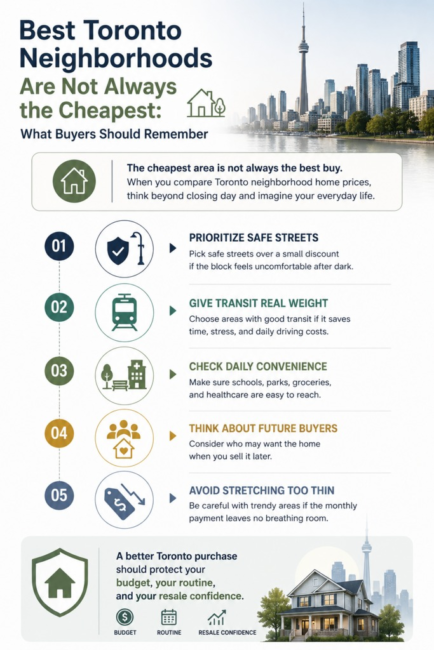
Best Toronto Neighborhoods Are Not Always the Cheapest: What Buyers Should Remember
The cheapest area is not always the best buy. When you compare Toronto neighborhood home prices, try to picture the home after the excitement of closing has passed and normal life has started.
- Pick safe streets over a small discount if the block feels uncomfortable after dark.
- Give transit real weight if it saves time, stress, and daily driving costs.
- Check how easily you can reach schools, parks, groceries, and healthcare.
- Think about who may want the home when you sell it later.
- Be careful with a trendy area if the monthly payment leaves no breathing room.
A better Toronto purchase should protect your budget, your routine, and your resale confidence.
Final Thoughts: Buy for the Life You Will Actually Live
A good Toronto purchase is not just the lowest price you can find. It is the place that still feels right after the keys, the first bills, and the daily commute become real. Use Toronto neighborhood home prices as a guide, but do not let the number make the whole decision for you. Check the street, the monthly cost, and the resale story. The right home should give you financial breathing room and everyday confidence.
FAQ About Toronto Neighborhood Home Prices in 2026
Are Toronto home prices moving the same way in every neighborhood?
Not really. One pocket can feel quiet, while another nearby area still gets strong attention. It often comes down to property type, street feel, transit, schools, and how many similar homes are available.
What should I check before choosing a Toronto neighborhood?
Start with the numbers, but do not stop there. Look at recently sold prices, your commute, parking, street safety, local shops, parks, and whether the area still feels comfortable after dark.
Are condos always the cheaper choice in Toronto?
They can be cheaper to buy, but that does not always mean cheaper to own. Condo fees, building age, rules, insurance issues, and reserve fund health can change the monthly cost quickly.
How do I know if a price is fair?
Compare homes that are truly similar. Size, condition, parking, outdoor space, renovations, street quality, and days on market all matter. Active listings show what sellers want. Sold prices show what buyers actually paid.
How should buyers use Toronto neighborhood home prices?
Use them as a starting point, not the full decision. The better choice is the home that fits your budget, daily routine, safety needs, and resale confidence after the excitement wears off.