
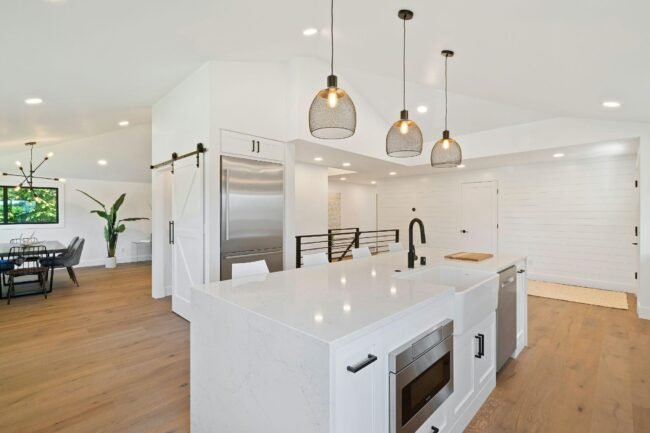
Every renovation decision eventually comes down to materials. You can have a flawless design plan, a well-managed budget, and a skilled contractor, but if the finishes you select are wrong for the space, the use, or the climate, the result will disappoint regardless of everything else that went right. Material selection is where most homeowners spend the least deliberate time and where the long-term success of a renovation is most often determined.
The choices that hold up over decades share common qualities: they are appropriate for their application, they are honest about what they are, and they are selected with an understanding of how they will age rather than only how they look on the day of installation.
Why Material Decisions Have Such Outsized Consequences
Finishes are the layer of your home you interact with constantly. You walk on them, lean against them, clean them, and look at them every day. A material that photographs beautifully but scratches easily, absorbs stains, or requires labour-intensive maintenance will erode your satisfaction with a renovation over time in a way that a slightly less visually striking but more practical choice never would.
The other reason material selection carries such weight is cost. High-quality finishes are expensive, and replacing them prematurely because they were wrong for the application is one of the most avoidable sources of renovation regret. Choosing correctly the first time is almost always less expensive than choosing impressively and replacing it in five years.
Flooring: The Foundation of Every Room
Hardwood and Engineered Wood
Solid hardwood remains the benchmark for residential flooring in primary living areas. Its warmth, longevity, and capacity to be refinished multiple times over its lifespan give it a value proposition that few alternatives can match. The trade-off is sensitivity to moisture and temperature fluctuation, which makes it a poor choice for bathrooms, below-grade spaces, and regions with significant seasonal humidity swings.
Engineered hardwood addresses the stability limitation by using a real wood veneer bonded to a plywood core. It performs significantly better in moisture-prone environments and over radiant heating systems, while retaining the visual quality of solid wood. The critical variable is the thickness of the veneer layer, which determines how many times the floor can be refinished over its life. Thicker veneers justify a higher price point for this reason.
Stone and Porcelain Tile
Natural stone, marble, travertine, slate, and limestone each age in distinct ways that need to be understood before selection. Marble is famously beautiful and famously porous. Without proper sealing and maintenance, it stains, etches from acidic contact, and shows wear patterns in high-traffic areas. In a low-traffic bathroom used by adults who understand its requirements, it is exceptional. In a family kitchen, it is a maintenance commitment that many homeowners find exhausting.
Large-format porcelain tile has improved dramatically in quality and visual realism, and in many applications it offers the aesthetic of natural stone with significantly better durability and lower maintenance. The grout lines are fewer with larger formats, which also means easier cleaning and a more seamless visual result. Rectified tiles, precision-cut for consistent sizing, allow for the tightest grout joints and the most refined finished appearance.
Cabinetry: Where Quality Hides in Plain Sight
Box Construction and Hardware
The quality of cabinetry is largely invisible to the untrained eye at the point of purchase, which is why it is so frequently where value is quietly extracted in renovation packages. The indicators that matter most are the construction of the cabinet box itself and the quality of the drawer and door hardware.
Plywood box construction is substantially more stable and durable than particleboard or MDF alternatives. It holds screws more reliably, resists moisture swelling, and maintains its structural integrity over decades rather than years. Dovetail drawer joints, full-extension drawer slides with soft-close mechanisms, and quality hinges with adjustable positioning are the hardware details that determine whether cabinetry feels precise and effortless to use after ten years or loose and frustrating.
Door Profile and Finish
Shaker-style cabinetry has dominated residential design for long enough that it has essentially moved from trend to default, which is partly because it is genuinely versatile and partly because it is well-understood by most manufacturers. Its longevity as a style choice is a practical advantage: you are unlikely to find it dated in fifteen years.
Painted finishes require a quality primer and top coat to avoid chipping and yellowing. Stained and natural wood finishes show the grain character of the material and age more gracefully in most cases. Lacquered finishes achieve the cleanest look but are more susceptible to visible scratching and require careful application to avoid runs and variation.
Countertops: Performance Under Daily Use
The countertop is the most actively used surface in a kitchen and one of the most scrutinised in a bathroom. It needs to resist heat, impact, staining, and constant cleaning without degrading in appearance.
Quartz engineered stone performs exceptionally well across all these criteria and does not require sealing. Its consistency of colour and pattern is both an advantage for design coordination and a limitation for those who prefer the organic variation of natural stone. Quartzite, frequently confused with quartz, is a natural metamorphic stone with genuinely striking veining and strong hardness, though it does require sealing and is more limited in availability than engineered alternatives.
Honed finishes on any countertop material, natural or engineered, show fewer surface scratches than polished alternatives because they do not have a reflective surface that makes marks visible. For high-use kitchens, a honed or leathered finish is often the more practical long-term choice.
Getting Material Selection Right
The technical knowledge required to match materials precisely to their applications, to understand how stone behaves in a wet environment or how a painted finish holds up in a high-touch area, is part of what experienced home renovation experts bring to a project. A contractor who has seen how different finishes perform over years of actual use in real homes is a resource worth drawing on before selections are finalised, not after.
Material decisions made in isolation, without input from the people who will be building with them and have seen how they age in practice, are the decisions most likely to produce regret.
The Principle That Connects Every Choice
The best material for any application is not the most expensive one or the most fashionable one. It is the one that performs reliably under the actual conditions it will face, ages in a way that is consistent with how you want your home to feel over time, and can be maintained without becoming a source of ongoing effort or anxiety.
That is a principle that applies equally to a marble bathroom in a luxury renovation and a hardwood floor in a modest family home. Quality is contextual. Durability is non-negotiable. And the finishes that define a home for decades are always the ones that were chosen with both in mind.