
A successful home renovation is rarely just about choosing finishes, furniture, or wall colors. Before a designer creates a new layout or a contractor starts demolition, the most important question is much simpler: how well do we actually know the space?
For many homeowners, renovation begins with inspiration. They collect ideas for kitchens, bathrooms, open-plan living areas, storage solutions, and energy-efficient upgrades. But inspiration alone is not enough. A beautiful concept can quickly become difficult to execute if the real dimensions of the home are not properly documented.
This is where ScanM2 becomes relevant for modern renovation planning. By creating accurate digital documentation of existing buildings, the company helps homeowners, designers, and contractors start with reliable information instead of rough measurements.
The Hidden Gap Between Design Ideas and Real Space
Home renovation often starts visually. A homeowner may want a larger kitchen island, a walk-in closet, built-in cabinetry, or a more open living area. These ideas can look perfect in mood boards or design references, but every home has physical limits.
Room proportions, wall thickness, ceiling height, window positions, slopes, corners, and hidden service routes all affect what can actually be built.
The challenge is not always obvious at the beginning. A room may look rectangular but measure slightly uneven. A ceiling may appear flat but vary from one side to another. A wall may seem suitable for built-in furniture but hide pipes, ducts, or structural elements.
When these details are missed, the renovation becomes harder to control.
Digital Documentation Before Design Decisions
Instead of treating measurement as a quick preparation step, modern renovation teams increasingly use digital building documentation as part of the design process.
This means creating an accurate digital record of the existing home before final design decisions are made. The goal is not only to measure walls, but to understand the entire spatial environment.
Digital documentation can help identify:
- usable room dimensions;
- ceiling height variations;
- window and door positions;
- structural limitations;
- areas suitable for custom furniture;
- possible conflicts with new layouts.
For homeowners, this makes the design process more realistic from the start.
Why This Matters for Interior Planning
Interior design often depends on precision. A kitchen layout, for example, may require exact measurements for cabinets, appliances, lighting, plumbing, and circulation space. A small mistake in measurement can affect the entire result.
The same applies to:
- bathroom redesigns;
- wardrobe systems;
- built-in storage;
- staircase improvements;
- attic conversions;
- basement upgrades;
- open-plan living transformations.
Accurate digital documentation helps designers plan these changes with fewer assumptions. It also gives contractors clearer information when estimating work and ordering materials.
From Physical Home to 3D Planning Environment
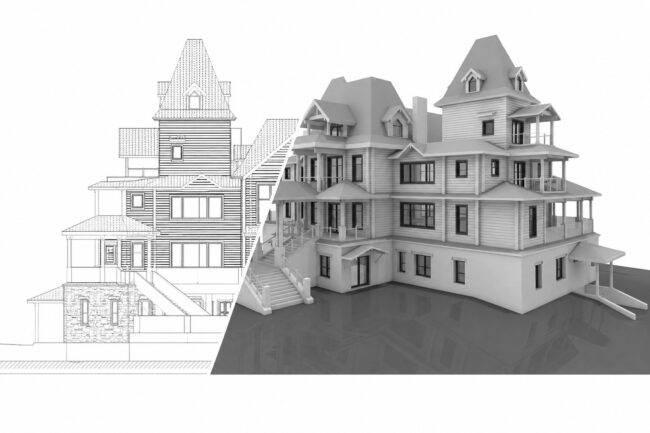
The value of digital documentation is not limited to flat drawings. A home can be transformed into a 3D planning environment that supports more confident decision-making.
Once the building is captured and processed, the data can be used to create 3D models or BIM-ready documentation. These models make it easier to understand how spaces connect, how volumes relate, and where design changes may be limited by existing conditions.
For homeowners, this can make renovation planning easier to visualize. For professionals, it creates a more accurate base for design development and construction coordination.
How ScanM2 Fits Into the Renovation Process
ScanM2 works with existing buildings by turning physical spaces into structured digital documentation. This may include 3D laser scanning, point cloud processing, as-built drawings, and 3D or BIM models.
The main advantage is that the homeowner, designer, and contractor can work from the same verified information.
This helps reduce misunderstandings such as:
- different people using different measurements;
- design concepts that do not match the real space;
- incorrect material orders;
- unclear scope for contractors;
- repeated site visits for additional measurements.
When everyone starts from the same digital base, the renovation process becomes more organized.
Better Planning Means Less Waste
Home renovation can create a surprising amount of waste. Incorrectly ordered materials, wrong-sized cabinets, unsuitable fixtures, and last-minute design changes often lead to unnecessary spending and discarded products.
Accurate documentation helps reduce this problem.
When dimensions are reliable, materials can be ordered more carefully. Custom pieces can be fabricated with greater confidence. Contractors can plan work sequences more efficiently.
For homeowners, this means fewer unexpected expenses. For the environment, it means fewer avoidable mistakes and less material waste.
A More Confident Way to Renovate
Modern homeowners want renovations that are beautiful, functional, and predictable. They want fewer surprises, clearer budgets, and better communication with professionals.
Digital building documentation supports all of these goals.
It gives the project a reliable foundation before design choices become construction decisions. It helps transform inspiration into something practical and buildable. Most importantly, it allows the renovation team to work with the home as it really is — not as it appears in outdated plans or rough measurements.
In this sense, digital documentation is becoming an essential part of smarter home renovation. It does not replace creativity, but it gives creativity the accuracy it needs to succeed.