
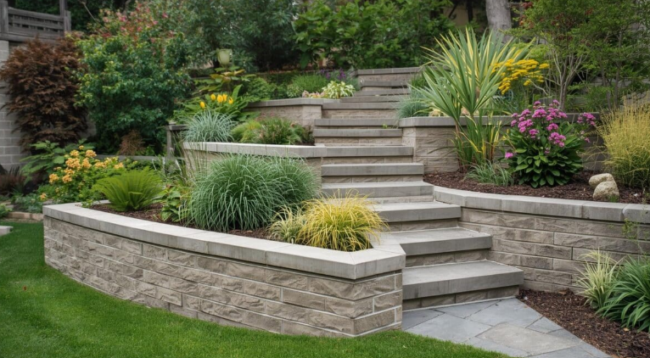
Construction on a sloping block in Sydney is a special problem that needs proper planning, professional skills and appropriate structural design. Compared to flat terrain, slanted land would require more considerations with regard to soil stability, water drainage, and load-bearing. The discussion is dominated by two essential components; retaining walls and foundations. When properly done, they will turn a tough slope into a safe, useful, and attractive property. Structural failures, broken foundations or even landslips can be caused by mistakes, however, which are expensive to fix. This paper has summarized all the details that Sydney homeowners and developers should know about these key elements.
Understanding the Challenges of Sloping Blocks
The topography in Sydney is well known to be diverse and most of the suburbs are constructed on the banks of rivers, on ridge lines and in escarpments. According to the sandstone cliffs of the North Shore to the clay-soaked slopes of the Inner West, every block is different. Sloping blocks are prone to surface runoff, erosion and differential settlement whereby one section of the building shifts more than the other. Unless well mitigated, the heavy rainfall during a Sydney summer storm may compromise the foundations, and drought may cause the clay soils to become shrunk and cracking foundations. This is the reason why it is not only recommended to involve a sloping block builder in Sydney at the early stages of the design process but it is quite critical. Such experts know local geology and are able to customize solutions to your local site conditions.
The use of Retaining Walls on a Sloping Land
Retaining walls are planned structures that are meant to retain soil and form levelable and usable lands on a slope. They inhibit landslides, water run-offs and can even be used as architectural elements. Some of the most used retaining walls materials in Sydney are reinforced concrete, sandstone blocks, timber sleepers, and masonry. The decision will be based on the height on the wall, the type of soil, and aesthetics. In the case of walls more than one metre in height, the NSW regulations require engineering certification. Drainage is also a major factor that should be considered, unless agi pipes and gravel backfill are installed, the pressure of the water will accumulate behind the wall, causing it to become bulged or collapsed. An effective retaining wall also lessens the pressure on the side of the foundations of your home making the building have a solid base. The retaining walls and footings are very interconnected and this is underestimated by many homeowners.
Considerations of the Foundations of Sloping Blocks
Sloping foundations should also have the capacity to withstand vertical (house weight) and horizontal (soil pushing downslope) forces. Normal slab-on-ground is not much of an option. Instead, engineers usually suggest bored piers, screw piles or stepped footings which are made in accordance with the natural land shape. Bored piers are dug deep into stable soil or rock, and they offload the loads off volatile surface strata. Stepped footings imply the pouring of concrete in a staircase type and minimises excavation and secures structural integrity. Raised floor system using stumps or piers can be cost effective when there is steeper slope. A geotechnical assessment of the site will be done by a qualified sloping block builder in Sydney to establish the best foundation system. Failure to do this has seen numerous Sydney houses end up with uneven floors, cracked walls, and sticking doors within a span of few years since the construction.
Soil Testing Requirements and Engineering
A geotechnical engineer needs to test your soil before 1 can start any excavation. Sydney has reactive clay which swells when moist and shruns when dry and Sandy soils that may easily erode. Based on the site, the engineer will categorize you as being of type M (moderately reactive), H (highly reactive), or E (extreme reactivity). This classification determines the depth of foundations, spacing between reinforcing, and wall supporting. As an illustration, a site of H-type on a 15 degree slope may take three metres deep piers reinforced by steel. Furthermore, a structural engineer should come up with the retaining wall design, which will withstand the active and passive earth pressures. The natural drainage patterns are also altered by cutting and filling the block and this may have an impact on the neighbouring properties. A conscientious sloping block builder in Sydney will organize such reports and make sure that all the engineering suggestions are taken to the latter.
Selecting the Appropriate Professional
Not all builders are experienced and insured to use sloping blocks. Normal residential constructors usually economize on drainage or use smaller footings, which cost a lot to fix in the future. During the interview with the candidates, request them to provide a list of the finished sloped projects, instances of cooperation with engineers, and testimonies of their former clients regarding the same terrain. The local council requirements such as setback variations, cut and fill limits and storm water management plans will also be well understood by a specialist sloping block builder in Sydney. They are expected to give a comprehensive methodology of their construction where they indicate how they will control the erosion, sediment and temporary shoring in case of excavation. Keep in mind: the lowest cost estimate is hardly ever the most appropriate where the stability of your home is concerned.
Sydney Council Regulations and Approvals
The majority of retaining walls more than 600mm in height and all foundation works on a slope will need a development application (DA) or a complying development certificate (CDC). The landslide prone land and watercourses have their specific overlays in Sydney councils including Northern Beaches, Sutherland Shire and Hills Shire. A geotechnical report, stormwater plan and structural drawings may also be required to be stamped by a chartered engineer. The inability to get the right approvals may lead to the issuance of stop work orders, fines, and demolition. Further, when your retaining wall or foundation collapses injuring the property of a neighbour, there are chances that you would be liable to pay repairs and legal expenses. This process is made much easier by involving a sloping block builder in Sydney who is in constant contact with certifiers at the council. They even have the tendency of seeing red flags before you present your application.
Maintenance and Longevity
Following a heavy rainfall, inspect weep holes, lean walls, cracks or standing water behind the building. Clean gutters and down pipes to have the roof water not to drain near foundations. In the case of timber retaining walls, prevent the infestation of termites which are a widespread pest in Sydney. In concrete or masonry, any cracks must be sealed as soon as possible to exclude the entry of water. Pier foundations may have to be re-leveled several decades after their construction, particularly on reactive clay. The fact that you have your as-built drawings and engineering reports in detail will help in the future repairs or sales of your property.
Conclusion
It is not a task that can be undertaken by the weakest hearted, but with the proper knowledge and team, it can provide us with a magnificent home to which we can gaze upon the most beautiful scenery and a character that would not have been experienced in flat areas. The retaining walls should be able to contain water and earth pressure, foundations should be able to withstand the vertical and horizontal forces. The steps that are not negotiable include geotechnical testing, engineering design, approvals by the council, and experienced construction. By contracting an experienced sloping block builder in Sydney working on challenging land, you not only save your money but also you have your home erected on secure grounds over generations. You have time to plan and your slope will turn out to be a business strength and not a business weakness.